Royal Air Force Air Ministry Issued Scarf
Year: 2025
Yarn: Casacade 220 in 904
Needles: US2 or 2.75mm 16’’ circular
Pattern: My pattern and available on Ravelry
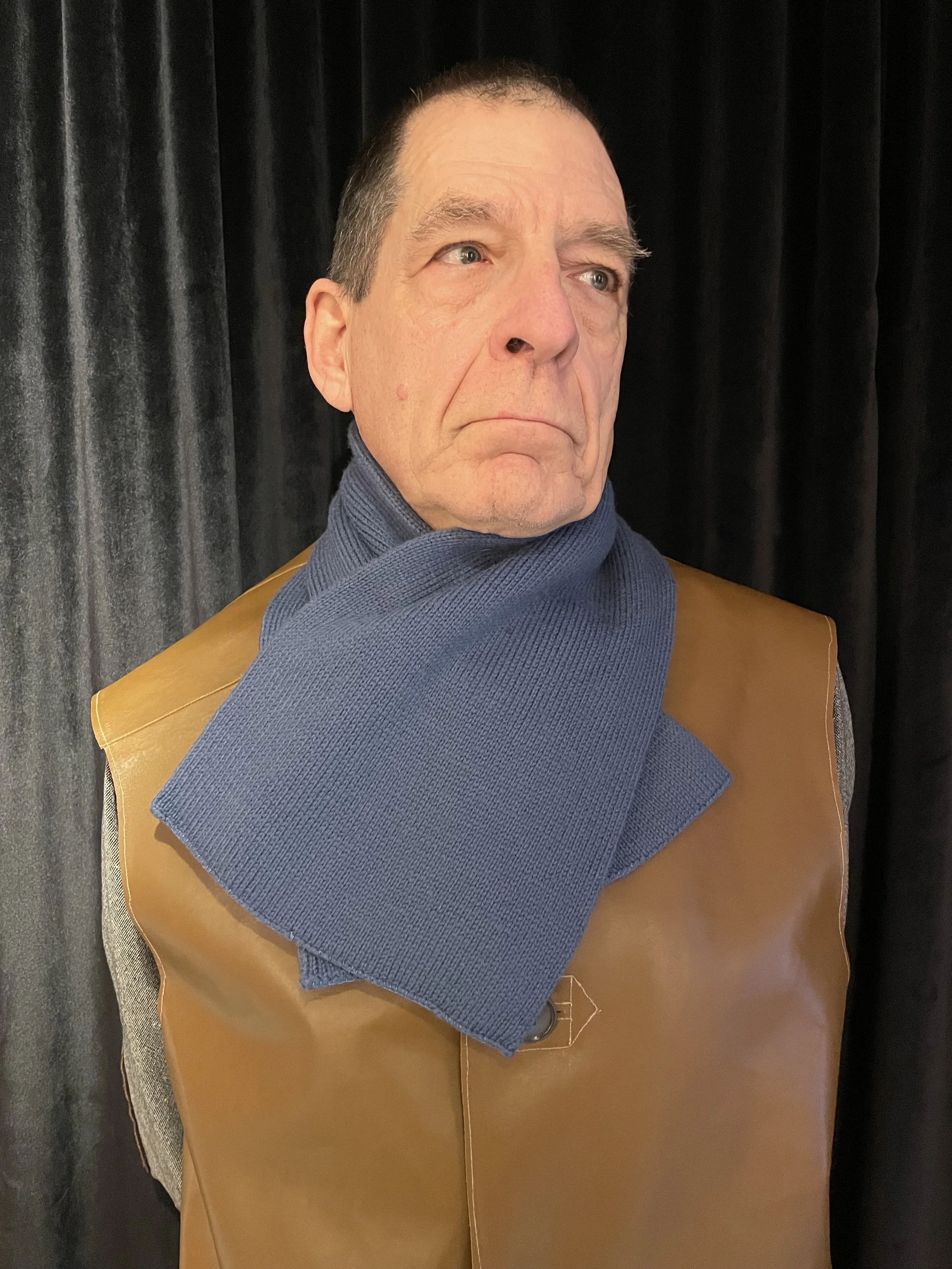
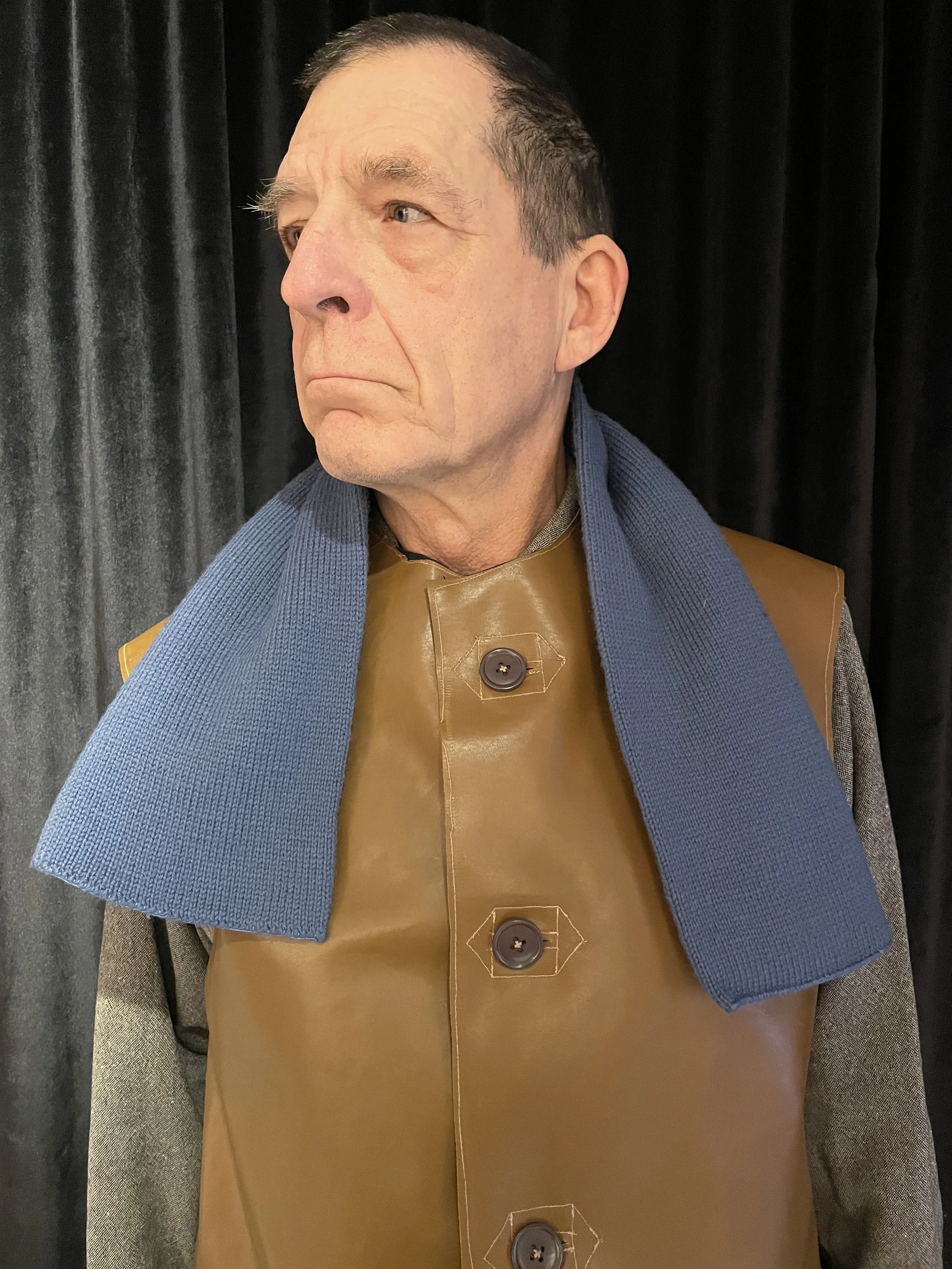
WWII 1940s Air Ministry, Royal Air Force Knitted Scarf
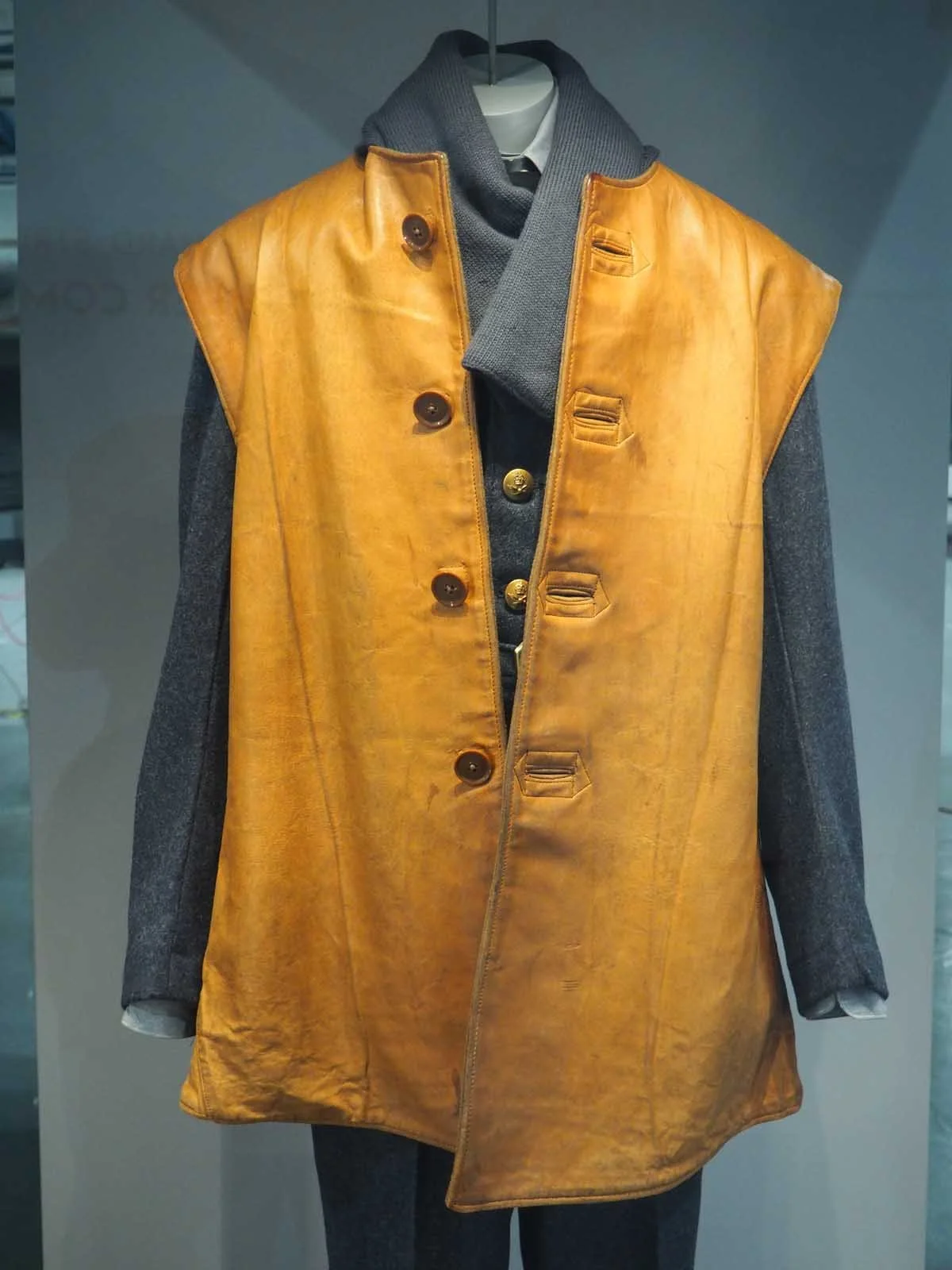
I first saw this scarf at the Royal Air Force Museum in Edgware, London. It was on a mannequin labeled as RAF Ground Crew uniform which included a leather jerkin. The scarf is knit blue wool and very dense. From my personal exercise with 1940s knitting patterns, a thicker yarn is often knit on smaller needles than we would consider knitting it on today. 1940s patterns often call for sport or thinner weight yarn, whereas today worsted and DK are more common. This scarf is likely a sport weight, however I’ve made this pattern using worsted since it is easier to find today in more of a variety of colours.
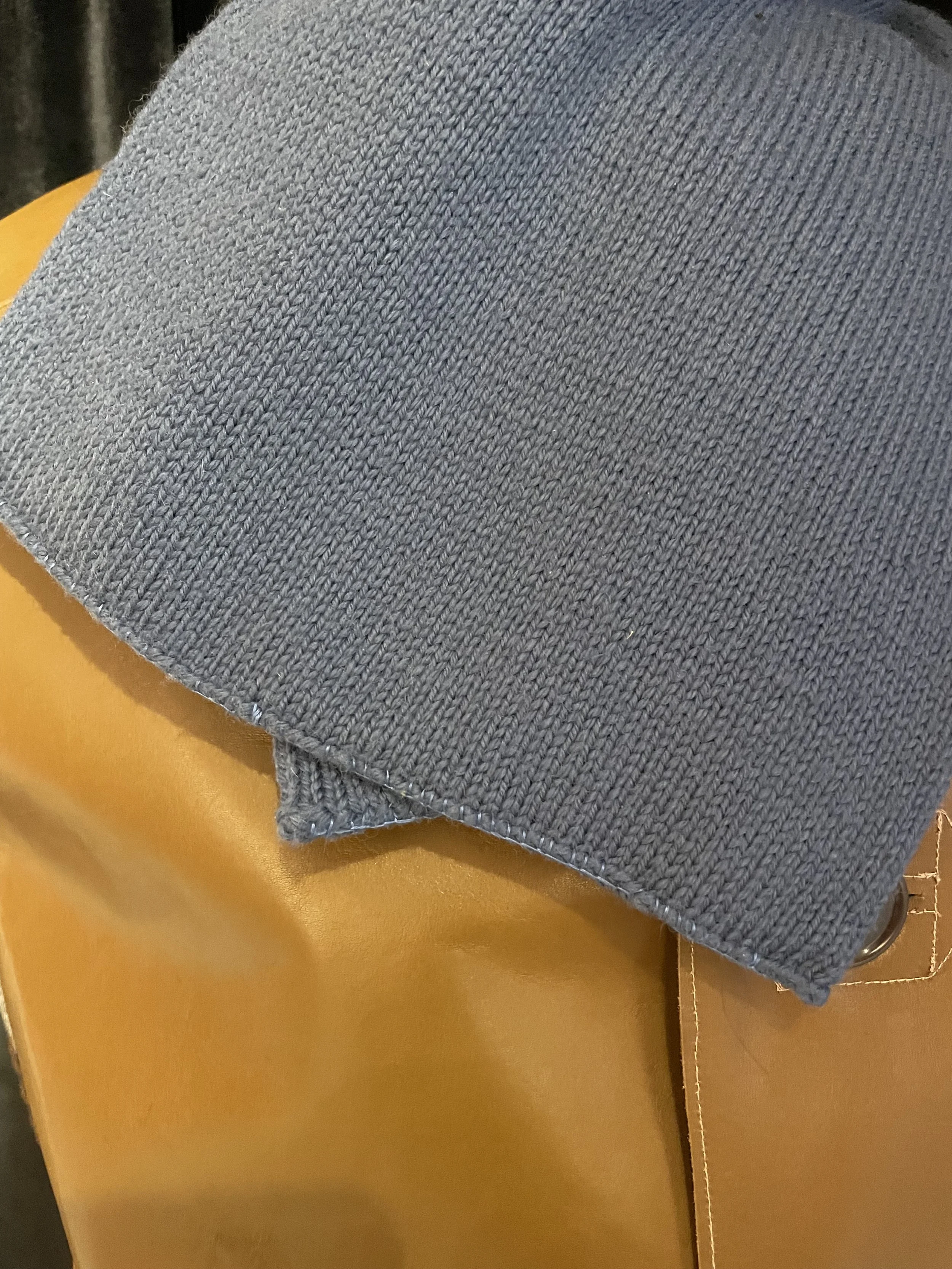
This scarf is a relatively short tube with closed ends that was likely knit on a circular knitting machine. The end are overlocked by machine. Therefore the recreation will be a little different when hand knit. I do not own an overlocker/serger so I made a change to the ends to compensate for this. This is a very close recreation using more hand knit methods. My method is knit in the round on circular needles and the ends are closed with a blanket stitch.
There are ways to make it more accurate for instance if you have an overlocker/serger and use Judy’s Magic Cast On to have a live edge on both ends, and overlock/serge the end after.
Here are two links to original scarves:
Abbreviations:
Sts: Stitches
CO: Cast on (I use long tail)
BOR: Beginning of round
K: Knit
Gauge:
Width, 6 sts/1inch
Materials:
Worsted Weight yarn. I used Cascade 220 Superwash in Colour 904, 3 balls (each ball is 100g/220 yards)
US 2 or 2.75 mm circular 16 inches or larger and use magic loop
Pattern:
CO 135 sts
Join in round being careful not to twist the stitches, Place marker for BOR, knit 5 rows.
Place marker on first stitch directly to the left of BOR. This will be the edge of the scarf.
Knit until piece measures 31 to 39 inches. The existing scarves are between these measurements.
Cast off.
Excerpt from term paper:
Knitting in WWII:
Knitting in WWII was very prominent on the home front. There are many surviving knitting patterns for “service” cardigans, vests, scarves, hats, gloves and more. During the war multiple yarn companies and other organizations from the Red Cross to the Salvation Army released patterns or pattern books under the slogan “Knit for Victory.”
In her University of British Colombia undergraduate thesis A New Arena of War: Knitting Needles in Action in Great Britain, 1939-1945, Lia Fairbairn explores the mobilization of women knitters in Britain between the years 1939-1945. She writes about the Knitting Scheme employed in Britain during the war: “The Knitting Scheme was a highly organized, nationally implemented movement. Women’s participation in this scheme constituted an important space between the home front and the front lines, and created a unique realm of active citizenship, rooted in feminine patriotism.” The number of knitters taking part in this scheme is unknown but is estimated to be over six-thousand. Fairbairn explores how knitting helped keep women in their “proper place” in the domestic sphere.
Traditionally, feminine contributions to the war effort were often overlooked in favour of the masculine, where “Knitting and other fibre and textiles are often dismissed as “women’s work” or “craft” rather than art, knitting is not a popular area of study.” Fairbairn concludes: “Knitting offers a way to look at women’s patriotic contributions to the war effort, while underscoring the ability for women to maintain or to subvert their femininity.”
In chapter three of her thesis Farbarin explored the militarization of knitting. While she does not discuss knitted items of issued uniforms she does explore badges offered by British services to voluntary knitters and the use of knitting in “sticky bomb” production. She also explores the use of knitting as a code, particularly by Special Operations Executive agents outwardly displaying innocent domesticity but in actuality recording information in code using knit and purl stitches.
British Air Ministry Scarf:
In terms of knitting explorations, I have completed a previous project of a knit cardigan from an original 1940s service cardigan pattern using a Make Do and Mend booklet. For that project I followed the instructions to unravel an existing sweater and reknit the yarn into a new one (Fig. 16).
For this class, I knit a British Air Ministry issued scarf. I assume that these scarves were originally knit on a machine in the round and then simply cut at the correct length. The original scarves that I have found online vary in length from thirty-one to thirty-nine inches. This indicates to me that these scarves were probably made quickly and perhaps not always measuring exactly the same length. The scarf is a tube of knitting that is serged or overlocked on the ends to prevent unravelling.
My pattern is therefore not an exact replica as it is a handmade version. I cast on and cast off my pattern in addition to knitting it by hand and not by machine. I also chose to sew the ends up by hand as I was unable to track down a serger in time, let alone finding the correct colour thread for the serger. This scarf is as close an approximation as a home knitter could have made with the limitation of hand knitting. However, I do not consider this a real limitation, as it does create a better quality scarf that will last longer. I counted stitches on photographs of the originals to obtain the correct gauge and then knit with worsted weight wool on 2.75 millimetre circular needles. To achieve the correct length I used six-hundred-and-sixty yards of wool. The finished scarf weighs just under three-hundred grams, whereas the original that measures thirty-one inches long weighs one-hundred-and-four grams.
Above is my written pattern for the knit scarf. This is published on the knitting website Ravelry. The pattern repeats some of the information written above.
There are many pattern websites online that have vintage knitting patterns. My challenge was to find one that was from 1941-1945 and British. Many patterns I found were American or Australian. Eventually, I discovered the archive of vintage knitting patterns on the University of Southampton’s digital library. I chose to follow a patten from the yarn company Patons & Baldwins titled, “No 2760 Women’s Service Cardigan.” It is clear it is a wartime pattern not only from the name but from the photograph on the cover of the pattern that shows a woman in the cardigan holding a wartime helmet. This cardigan took approximately two and half months to knit. I had my doubts about the finished piece when I saw the shape of the flat pieces. The increase from the waist section seemed too extreme and not graded enough however when wearing the cardigan, it is smooth on the sides and that increase accommodates for the bust perfectly. A mantra I repeat to myself constantly while knitting is “trust the pattern” and in this case the pattern was correct.
I knit the cardigan on needles handed down to me by my grandmother. She was born in England in 1928 so was a teenager during the war. My mother remembers her telling stories of watching flashes of light from exploding bombs coming into the house underneath the door. My grandmother moved to Canada in the early 1950’s. She was a prolific knitter likely bringing needles with her from the UK which I have since inherited. Most of these needles are labelled with the old UK sizes which the World War II patterns called for. The old UK size was based off the imperial wire gages and likely changed after the UK changed to metric in 1965. I was therefore only able to use the correct needles for the pattern (even though a modern pair would have been the same sizes in millimetres), I was also using needles that were used by her and bent over time by her hands. Knitting needles, both wood and metal, when used by a knitter have a tendency to get a bend in them from how the knitter holds them.
Craft historian Glenn Adamson writes about how memory is infused in craft in a variety of ways. He writes how “Artisans forge objects of memory that allow us to articulate…between the present and the past and therefore between the individual and the collective.” (Adamson, 2013, 210.) For me this cardigan creates a through-line between my grandmother's past and my present, between our individual selves, and together her and I, as a collective of makers who have used these tools.